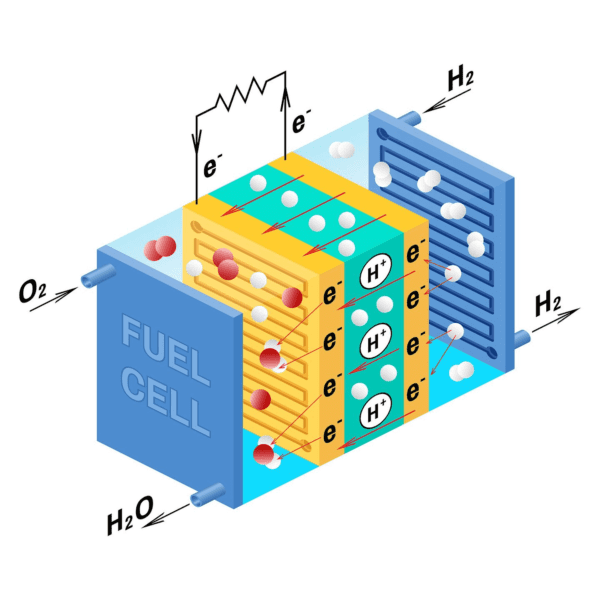
PEM fuel cells generate power by capturing the electrons that flow between the anode and cathode side of the membrane. As the theoretical maximum voltage between hydrogen and oxygen is 1.23V the only way to increase this voltage is by stacking these cells, hence the name a fuel cell stack.
The amount of current that can be drawn from a fuel cell is dependent on the amount of gas that flows through the fuel cell and the required amount of gas can be calculated by the following equations:

Figure 1: Fuel cell flow calculations, please note that the numbers used for the gas density are based on 20C gas
These calculations show that the more gas is being supplied, the higher the current can be. In theory the current can be unlimited based on sufficient gas supply, however fuel cells have their own specific resistance both electrical resistance as well as proton resistance limiting the current and therefore power output of a fuel cell
Output power of a PEM fuel cell
Back to understanding the power of PEM fuel cell. The performance of a PEM fuel cell is often depicted in a polarisation curve or IV curve.
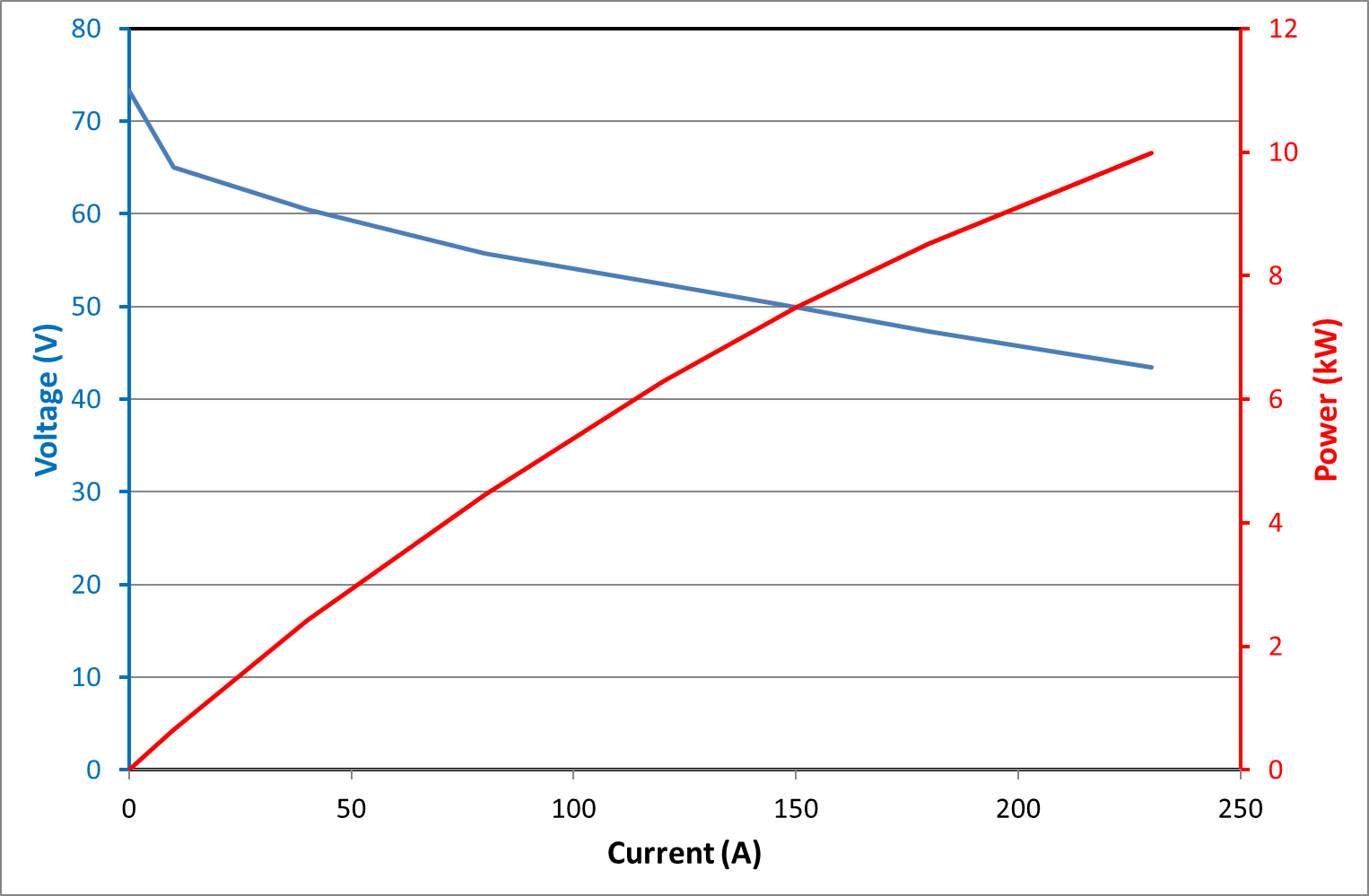
Figure 2: A typical polarisation curve of a fuel cell stack no bigger than 36dm². On the left hand side the stack voltage can be found, whereas on the right hand side the power output can be found
As can be seen in Figure 2, the power output of a fuel cell stack is quite impressive. This is sufficient power to provide electricity for several households or when using multiple to power the drive train of a car, bus, train or ship.
Now the power generated by a fuel cell, as it has a plus and minus, is what we call direct current (DC) and if it needs to be supplied to the grid it will need to be converted to alternating current. This conversion is done by an inverter (same as the ones in use with solar panels in your home), which will consume a small amount of power, leaving a substantial amount of power to be used.