Introduction
Catalyst slurry or ink application can be done in several ways. But first it is good to work on a bit nomenclature as the industry is riddled with them.
GDL: Gas Diffusion Layer
GDE: Gas Diffusion Electrode (a with catalyst ink or slurry coated gas diffusion layer)
CCM: Catalyst Coated Membrane (a membrane with catalyst coated on both sides)
These abbreviations will more than once come back in any of the literature
As mentioned there are various ways to apply ink to one of the before mentioned substrates. To get a bit of an understanding some of them have been listed below including one of their advantage versus a disadvantage

Now it must be pointed out that decal is not really a printing technique as decal is a transfer technique. Creating a decal requires ink application onto a transfer film and transfer from this film (decal) onto a substrate.
Currently there are various new techniques in either development or on the verge of being commercial available. Though they haven’t been added in this table, this is due to their immaturity, vastly different process or, to our opinion, lacking performance. One of these processes though we regard worthwhile mentioning and that is the one of spark ablation . Spark ablation is a technique where a solid metal surface is being bombarded with electron vaporising ionised metals, these metals quickly form nanoparticles which are remain dispersed in gas as an aerosol. This aerosol can than be transported to a substrate where the particles deposit themselves onto. Electrodes perpared with this method show promising results and samples can be attained from our webshop LINK TO VSPARTICLES ELECTRODES HERE
Picking one of these application methods is mainly based on the budget and requirements one has. For instance if you want to use a carbon supported PGM (80%wt carbon – 20%wt PGM) and want to apply 0.2mg PGM/cm², spraying will most likely, not be your preferred choice.
There are numerous considerations why to choose a application technique to create electrodes. PEM components is willing to offer its expertise in a consulting session, helping which technique is the most suited for your operation
Screen printing
Screen printing is a very simple technique, which relies on a mesh screen with an open mesh template. Through this open mesh template ink will be pushed through onto a substrate. Typical viscosities of the ink are in the range of yoghurt and custard. If your viscosity is too low ink will diffuse through open mesh and drip on the substrate causing inhomogeneity and loss of reproducibility. If the viscosity is too high, ink will not diffuse through the open mesh in the screen, leaving the substrate dry. Evaporation of ink is another parameter to take into account, as well as the chemical stability of the screen and numerous other parameters. PEM components can help tailoring your process to be succesful
Screen printing
- Screen printing machine
- Screen
- Catalyst slurry
- Tape, preferbly Scotch magic tape
- Substrates
- Analytical balance
- Spatula
- Paper towells
Screen printing
- Weigh the clean and cut to size substrate
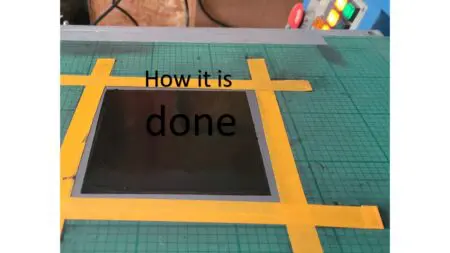
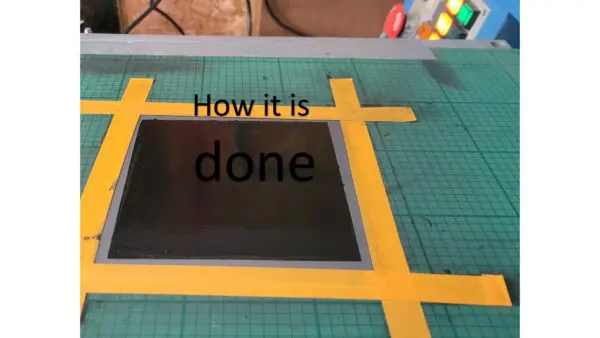
- Fixate the substrate with tape on the screen printer table so it aligns with the open mesh
- Apply a sufficient amount of ink about 1 cm in front of the mesh opening
- Initiate the screen printing process
- Remove the substrate from the table
- Weigh the substrate
Video of the screen printing process in operation
PEM components
PEM components offer a wide variety of services, including assistance with catalyst slurry or ink application techniques as well as application. Based on their vast experience with catalyst slurry or ink application to form high quality electrodes and their well suited laboratory they are happy to assist you in your endeavours to succeed.