Introduction
Catalyst slurrry also known as (catalyst) ink due to its general black color is a dispersion consisting of catalyst powder, ionomer and solvent(s). In this procedure several purposes are served:
- Catalyst powder is dispersed in a liquid allowing easier application
- Catalyst powder and ionomer are mixed allowing for proton transport between the bulk of catalyst and membrane
- Catalyst particles can be “broken” apart further allowing for a higher surface area
Ink composition vary from application method, though always include catalyst material and ionomer. Main difference can be found in solvent type and amount. The application type defines the viscosity of the ink, whereas the solvent type defines the evaporation rate, the intermolecular behavior and the dispersion stability.
Introduction
Viscosity is a key indicator of the quality of an ink. Preferbly one want to measure the rheology of an ink as it gives a superior insight. Typical inks behave in a non-newtonian manner, therefore just a single shear rate as most viscosimeters provide can be tricky, as inks are a dispersion with a plasticising compound in them. The rheological spectrum of one of our inks can be found below to give an idea

Figure 1: The rheological spectra of a catalyst ink based on carbon supported PGM, solvent and Nafion dispersion. The first bit between 0rpm and 50rpm show an exponential decrease in viscosity as the connections between the plasticising compound and catalyst material are broken apart and become fluid. After 50rpm the viscosity is behaving more or less linear such as would you expect from a fluid. The moment this phase change takes place tells about the ink composition. The initial viscosity can tell about the surface area the catalyst will have after dispersion. A more in depth explanation about viscosity and rheometry will follow in a separate article.
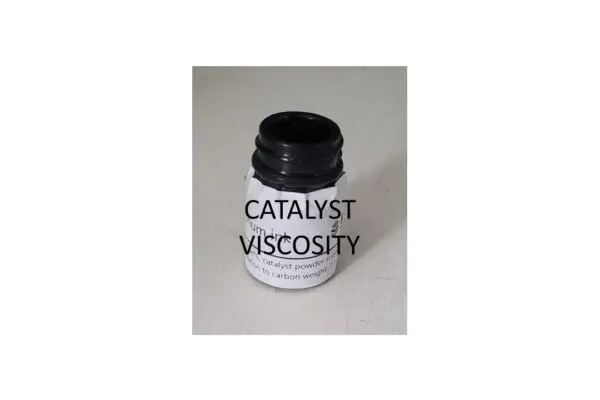
This type of ink will be suited for slot die coating, brush coating, screen printing, gravure printing, wire bar coating. For spraying and inkjet printing one would like an ink that has a significant lower viscosity and preferbly require very few friction for its interconnecting networks to break apart. The reason to it is simple, the ink will simple clog the spray needle preventing homogeneous application.
Introduction
There are many factors that can influence solvent selection, just to name a few in random order:
- Evaporation rate
- Polarity
- Price
- Environmental effects (at large scale usage)
- Volatility
- Compatability with ionomer
It is not difficult to write a book about solvent selection, but that is not the intention of this introduction in “how it is done” and besides academical literature is readily available on this subject. Regarding solvents used, usually ionomer prefers to be in a (slightly) polar solvent for its dispersion to remain intact
Introduction
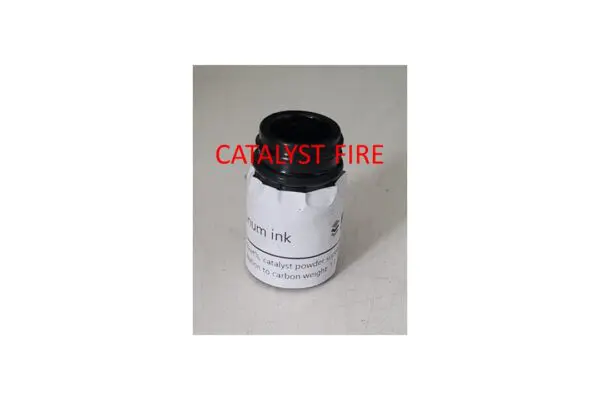
Catalyst slurry preparation does come with some safety concerns especially if one adds a combustable solvent to the catalyst powder or catalyst powder to a combustable solvent as the catalyst likes to oxidise everything. And yes with oxidise, create fire is meant. The severity depends on the air / solvent / aerosolised catalyst powder ratio. As an experienced user I have seen everything between a bit of smoke coming of the ink and the write off an analytical balance. Work arounds such as purging the container with an inert gas (Argon is recommended, though other work too) can help, but will not eliminate the issue as air and specifically the oxygen can be trapped within the catalyst powder. If you are an inexperienced user and need to prepare an ink for the first time, bear in mind that this can happen. If you see the first signs of smoke flush the container with water, wet all the catalyst with a spatula or some sort and dispose the mixture according to local regulations.
PEM components, which is bound to Dutch regulations, proceeds in such case the following:
- Flush the container with water and seal it off
- Shake the sealed container until all catalyst is wetted
- Open the container and dry off all solvents
- Collect the remaining catalyst cake and store in a PGM waste bin
Note that the PGM waste bin is a self extinguishing bin, sitting in a ventilated fire proof enclosure
Catalyst slurry preparation
Slurry preparation or ink preparation is a very straight forward process. It is basically mixing the catalyst material with the ionomer in a solvent. There are however some safety concerns when one wants to do so as exactly described, namely the catalyst material will most likely oxidise the solvent of the ionomer dispersion. It is highly recommendable to add water first to the catalyst before any solvent is introduced as water will act as a barrier.
Regarding the dispersing a magnetic stirrer will already mix the catalyst, ionomer and solvents sufficiently to a homogeneous paste, but it has been found that more vigorous dispersing such as ultrasonicfication or ball milling provide much higher electrochemical surface area’s. Downside of ultrasonification and ball milling is that the necessary equipment is expensive. A more economical method to enhance the surface area is by using a high shear mixer.
Catalyst slurry preparation
- A dispersing/mixing machine
- Container with lid, preferbly glass
- Analytical balance
- Spatula, preferably porcelain or glass, avoid polymer based
- Dripping pipette
- Catalyst powder
- Ionomer solution/dispersion
- De-ionised water
- Solvent
Catalyst slurry preparation
It is highly recommendable to place a (crystallization) dish on the scale platform in which the catalyst ink container generously fits. Catalyst powder is very fluffy and easily spilled next to the container. Apart from the value of catalyst, it also easily stains porous surfaces such as that of a analytical balance. Filter paper, office paper or wiping tissue can be used, but will not allow for easy repatriation of catalyst powder.
- Label the container and place it on the scale and write down the weight, then tare
- Carefully add the required amount of catalyst in the container with help from the spatula and write down the weight, then tare
- Add sufficient de-ionised water to the catalyst powder in the container with help from a dripping pipette and write down the weight, then tare
- Steps 4 and 5 are the steps most likely prone to cause spontaneous combustion of the catalyst mixture. If you observe formation of smoke, seal of the container and wait until the temperature of the container has decreased to room temperature
- Carefully add the solvent to the container, drip solvent by dropping it onto the moisturised catalyst powder write down the weight, then tare
- Carefully add the ionomer dispersion/solution to the container, write down the weight
- Mix the content of the container with a spatula to moisturize all catalyst powder
- Disperse the catalyst slurry with the mixing/dispersing machine
- Your ink is ready to go
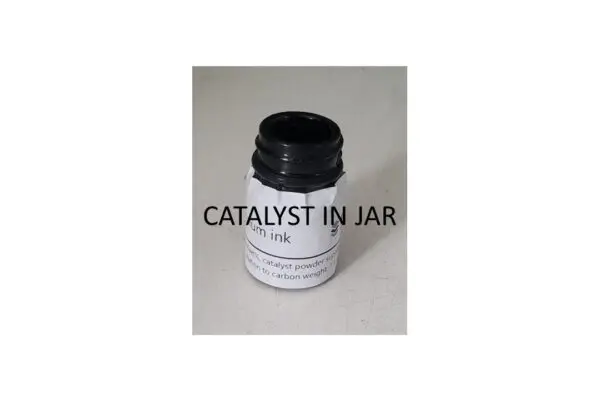
It is recommended to store catalyst ink in a refrigerator. By lowering the temperature not only the combustibility lowers, but the dispersion tends to remain stable for a longer period of time. It is advisable to shortly mix a stored catalyst ink prior to using. Typical ink shelf life depends on numerous factors, though 1 week should be easily achieved
Catalyst slurry preparation
After the ink has been prepared a number of calculations should be made prior to usage, such as PGM fraction. Depending on the application method PGM fraction in either the ink itself or in the dry mass of the ink should be obtained
The ratio ionomer to carbon or, in case of a solution, the ratio ionomer to surface area of the catalyst should be calculated beforehand as it gives insight in the actual ink formulation. When using Nafion and a carbon supported platinum catalyst, a ratio of 1g carbon per 1g of Nafion is a good starting point. If you want something more fitting then please consult the literature as it various applications, uses and procedures are described including formulations.